


 Bandra
 Kandivali
 Juhu
Juhu

What Is Keratoconus Treatment?
Keratoconus treatment focuses on managing a condition in which the cornea, the clear front surface of the eye, becomes thinner and gradually bulges outward into a cone-like shape. This change affects the way light enters the eye and can lead to blurred, distorted and fluctuating vision.
Keratoconus usually develops during the teenage years or early adulthood and may progress over time. If left untreated, the condition can significantly affect vision and daily activities.
At Ojas Maxivision Eye Hospital in Mumbai, our cornea specialists use advanced diagnostic procedures to detect keratoconus at an early stage and recommend personalized treatment plans based on the severity and progression of the disease.

How Does Keratoconus Treatment Help Improve Vision?
Keratoconus treatment aims to stabilize the cornea and improve visual quality. Depending on the stage of the condition, treatment may help:
- Slow or stop disease progression
- Reduce visual distortion
- Improve vision clarity
- Correct irregular astigmatism
- Improve contact lens comfort
- Lower the risk of severe corneal damage
- Reduce the likelihood of requiring a corneal transplant
Early diagnosis and treatment play an important role in protecting long-term vision.
Why Is Keratoconus Treatment Performed?
The primary purpose of keratoconus treatment is to prevent further weakening of the cornea and preserve vision.
Treatment may be recommended if a patient:
- Experiences worsening vision
- Has frequent spectacle prescription changes
- Develops increasing corneal steepening
- Shows progression on corneal scans
- Has difficulty achieving clear vision with glasses
- Experiences glare, halos or distorted vision
- Has significant irregular astigmatism
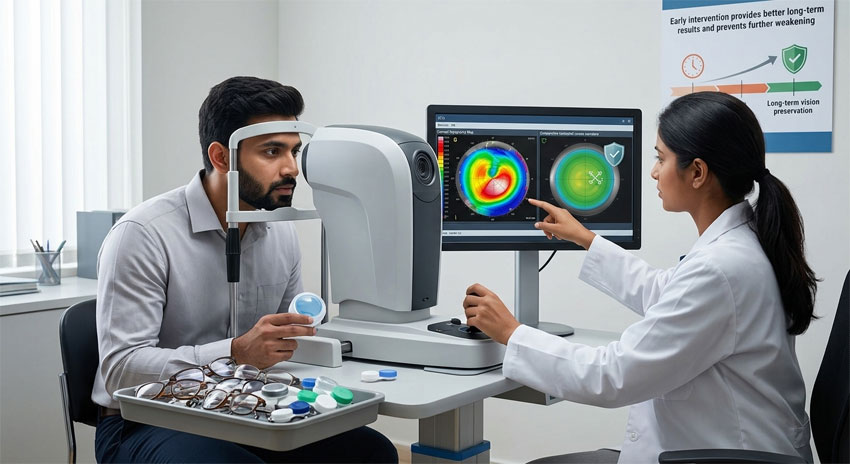
Early intervention often provides better long-term visual results.
Note: The main goal of keratoconus treatment is to stabilize the cornea and preserve vision. Some treatments improve vision, while others primarily prevent further progression.
Why Is Keratoconus Treatment Considered Important for Long-Term Vision?
Keratoconus is a progressive condition. Without timely treatment, the cornea may continue to thin and bulge, leading to worsening vision and in severe cases, corneal scarring.
Purpose of keratoconus treatment:
- Stabilizes the cornea: Helps prevent further weakening and bulging.
- Preserves vision: Reduces the risk of future visual deterioration.
- Improves visual quality: Corrects irregular focusing caused by corneal distortion.
- Reduces disease progression: Particularly through corneal cross-linking.
- Delays or prevents corneal transplantation: Early treatment may help avoid advanced surgery.
- Enhances quality of life: Allows patients to perform daily activities more comfortably.
Who Can Benefit from Keratoconus Treatment?
People of different age groups and stages of keratoconus may benefit from treatment. Early diagnosis and timely intervention can help preserve vision, slow disease progression and improve overall visual quality and comfort.
Keratoconus treatment may benefit:
- Teenagers diagnosed with early keratoconus
- Young adults with progressive disease
- Patients experiencing increasing astigmatism
- Individuals with blurred or distorted vision
- People with irregular corneal shape detected on scans
- Patients struggling with contact lens fitting
- Individuals with corneal thinning disorders
A detailed eye examination helps determine the most suitable treatment option.
Who May Not Be Suitable for Certain Keratoconus Treatments?
While keratoconus treatment can benefit many patients, certain procedures may not be suitable for everyone. A detailed eye examination helps determine the safest and most effective treatment approach based on the condition of the cornea and overall eye health.
Alternative approaches may be required for:
- Patients with severe corneal scarring
- Extremely thin corneas
- Active eye infections
- Significant ocular surface disease
- Uncontrolled eye inflammation
- Certain advanced corneal disorders
The eye specialist will recommend the safest and most effective treatment based on your individual eye condition.
What Symptoms May Indicate the Need for Keratoconus Treatment?
Keratoconus is a condition in which the cornea gradually becomes thinner and changes shape, affecting the way light enters the eye. As the condition progresses, vision may become increasingly distorted and difficult to correct with regular glasses. Early diagnosis and timely treatment are important to help slow disease progression and protect long-term vision.
Common symptoms that might indicate the need for keratoconus treatment may include:
Blurred or distorted vision: Objects may appear unclear, wavy or out of focus.
Increasing astigmatism: Vision becomes more distorted due to irregular corneal curvature.
Frequent changes in spectacle number: Eyeglass prescriptions may change more often than usual.
Sensitivity to light: Bright lights may cause discomfort or excessive glare.
Difficulty seeing at night: Driving or seeing clearly in low-light conditions may become challenging.
Halos and glare around lights: Rings, streaks or starbursts may appear around headlights and other light sources.
Double vision in one eye: Multiple images may be seen even when one eye is closed.
Eye strain or frequent headaches: Visual distortion can make focusing difficult and tiring.
Sudden worsening of vision: Some patients may notice a rapid decline in visual clarity as the condition progresses.
Anyone experiencing these symptoms should undergo a detailed corneal evaluation at the earliest, as early treatment can help preserve vision and reduce the risk of advanced keratoconus.
What Are the Different Types of Keratoconus Treatment?
Several treatment options are available for keratoconus, depending on the stage of the condition, the degree of corneal thinning and the patient's visual needs. The main goals of treatment are to improve vision, stabilize the cornea and prevent further progression of the disease.
Glasses and Contact Lenses
In the early stages of keratoconus, eyeglasses or soft contact lenses may help correct blurred vision. As the condition progresses and the cornea becomes more irregular, specialized contact lenses may be recommended for better visual clarity.
These may include:
- Rigid Gas Permeable (RGP) lenses
- Hybrid contact lenses
- Scleral lenses
- Custom-designed keratoconus lenses
Corneal Collagen Cross-Linking (CXL)
Corneal Cross-Linking is one of the most commonly recommended treatments for progressive keratoconus. This minimally invasive procedure uses riboflavin (Vitamin B2) eye drops and ultraviolet (UV) light to strengthen the corneal tissue. The treatment helps slow or stop further progression of keratoconus and may reduce the risk of severe vision loss.
Intracorneal Ring Segments (ICRS)
Intracorneal Ring Segments, commonly known as Intacs, are tiny crescent-shaped implants placed within the cornea. These implants help flatten and reshape the cornea, improving its curvature and enhancing vision in selected patients with mild to moderate keratoconus.
CAIRS ( Corneal Allogenic Intra stromal Ring Segments )
These are ring segments fashioned from human eye tissue procured after eye donation. The mechanism of action is similar to INTACS but the risk of extrusion of the ring is very less. And as the tissue is biocompatible, there is no long term adverse effect on the eyes.
Implantable Collamer Lens (ICL)
Some patients with stable keratoconus who are not suitable candidates for laser vision correction may benefit from Implantable Collamer Lens (ICL) surgery. An artificial lens is placed inside the eye to improve vision while preserving the natural corneal structure.
Topography-Guided Customized Treatment
Advanced topography-guided procedures use detailed corneal mapping to address irregularities in the corneal surface. In selected cases, these treatments may be combined with corneal cross-linking to improve vision quality and corneal stability.
Corneal Transplant Surgery
In advanced keratoconus cases where significant corneal scarring, severe thinning or poor vision is present, a corneal transplant may be required.
Types of corneal transplant surgery include:
- Deep Anterior Lamellar Keratoplasty (DALK): Replaces the damaged front layers of the cornea while preserving the healthy inner layer.
- Penetrating Keratoplasty (PK): A full-thickness corneal transplant used in more advanced cases.
The most suitable treatment depends on the severity of keratoconus, corneal thickness, visual requirements and overall eye health. A comprehensive eye examination and corneal evaluation help determine the safest and most effective treatment plan for each patient.
How Is Keratoconus Treatment Performed?
The treatment process varies depending on the severity of the condition.
Step-by-step evaluation process:
- Detailed eye examination
- Vision assessment
- Corneal topography
- Corneal tomography
- Corneal thickness measurement
- Assessment of disease progression
- Selection of the most suitable treatment plan
For patients undergoing corneal cross-linking:
- Riboflavin eye drops are applied
- Ultraviolet light is used under controlled conditions
- Corneal collagen fibers become stronger
- Progression is slowed or halted
Most patients return home on the same day.
What Are the Benefits of Keratoconus Treatment?
Keratoconus treatment offers several important benefits by helping stabilize the cornea, improve vision and reduce the risk of disease progression. Early diagnosis and timely treatment can help preserve long-term eye health and support better quality of life.
Benefits of keratoconus treatment include:
- Slows disease progression
- Stabilizes corneal structure
- Improves visual quality
- Reduces visual distortion
- Enhances daily functioning
- Improves contact lens fitting
- Helps preserve long-term vision
- Supports better quality of life
- May reduce the need for corneal transplantation
Early treatment often provides the most favorable results.

What Are the Risks and Side Effects of Keratoconus Treatment?
Like all medical procedures, some treatments may involve temporary side effects.
Possible risks may include:
- Eye discomfort
- Light sensitivity
- Temporary blurred vision
- Dryness
- Mild inflammation
- Infection (rare)
- Corneal haze
- Delayed healing
- Glare or halos during recovery
Most side effects are temporary and improve with proper care and follow-up.
What Is the Recovery Process After Keratoconus Treatment?
Recovery time after keratoconus treatment varies depending on the type of treatment performed. Some procedures may require only a few days of recovery, while others can take several weeks or months for vision and the cornea to fully stabilize. Your eye specialist will guide you on the expected recovery timeline based on your individual treatment plan and eye condition. Patients should attend all scheduled follow-up appointments.
What Are the Important Aftercare Tips Following Keratoconus Treatment?
Proper eye care and healthy habits can help support recovery, protect the cornea and reduce the risk of further progression of keratoconus. Following your doctor's advice and attending regular follow-up visits are important for maintaining long-term eye health.
- Avoid rubbing your eyes: Frequent eye rubbing can weaken the cornea and may worsen keratoconus. If you experience itching or irritation, consult your doctor for appropriate treatment.
- Protect your eyes: Wear sunglasses outdoors to reduce exposure to bright sunlight, dust and environmental irritants.
- Maintain a healthy diet: A balanced diet rich in fruits, vegetables, vitamins and antioxidants supports overall eye health.
- Maintain adequate Vitamin D levels: Some studies suggest that maintaining healthy Vitamin D levels may support corneal health, although more research is needed.
- Use prescribed medicines regularly: Follow the recommended schedule for eye drops and medications to support healing and prevent complications.
- Manage allergies and dry eyes: Allergies and dry eye disease can increase eye irritation and the urge to rub your eyes. Proper treatment can help improve comfort and protect the cornea.
- Attend regular eye check-ups: Routine follow-up visits help monitor corneal stability and ensure timely management if any changes occur.
- Report new symptoms immediately: Contact your eye specialist if you notice worsening vision, increasing discomfort, redness or any unusual eye symptoms.
Following these simple precautions can help support better visual results and long-term management of keratoconus.
Book Your Appointment for Keratoconus Treatment in Mumbai at Ojas Maxivision Eye Hospital
If you are experiencing blurred vision, increasing astigmatism or frequent changes in your spectacle number, an early evaluation can help detect keratoconus before significant vision loss occurs.
At Ojas Maxivision Eye Hospital, our experienced cornea specialists provide advanced diagnostic evaluation and personalized treatment plans to help preserve long-term vision. If you are looking for an eye hospital in Mumbai or seeking expert keratoconus treatment in Mumbai, our team is here to take care of your eye.
Frequently Asked Questions About Keratoconus Treatment
The first-line treatment for keratoconus depends on the stage of the condition. In the early stages, glasses or specialty contact lenses such as rigid gas permeable (RGP) lenses and scleral lenses are commonly used to improve vision. If keratoconus is progressing, corneal collagen cross-linking (CXL) is often recommended to strengthen the cornea and help prevent further worsening of the condition.
A corneal transplant can last for many years and in many cases, may remain successful for a lifetime if the transplanted cornea is accepted by the body. Regular follow-up visits and prescribed medications are important to maintain graft health. In some cases, graft rejection or failure may occur, requiring additional treatment or repeat surgery.
Yes, keratoconus treatments are generally very successful when diagnosed and treated early. Treatments such as corneal cross-linking can help slow or stop disease progression, while specialty contact lenses and other procedures can improve vision. Advanced cases may require corneal transplantation, which also has a high success rate when properly managed.
The best treatment for keratoconus varies from person to person and depends on the severity of the condition. Corneal collagen cross-linking is often considered the preferred treatment for progressive keratoconus because it helps stabilize the cornea. Other treatment options may include specialty contact lenses, intracorneal ring segments (INTACS) or corneal transplant surgery in advanced cases.
No, LASIK is generally not recommended for people with keratoconus. Since keratoconus causes the cornea to become thin and weak, LASIK can further weaken the corneal structure and increase the risk of vision problems. Safer alternatives such as corneal cross-linking, scleral lenses or other keratoconus treatments are usually recommended by eye specialists.
The cost depends on the severity of the condition, type of treatment, technology used and individual treatment requirements. A detailed consultation helps determine the most appropriate treatment plan and estimate. Please get in touch with us by phone or email to schedule your appointment.
Yes, Ojas Maxivision Eye Hospital offers cashless treatment facilities for various eye treatments through selected insurance providers and empanelled organizations. The hospital is associated with various government and corporate panels, including CGHS, RBI, NABARD and BSNL. Patients are advised to contact the hospital in advance to confirm insurance eligibility, coverage details and required approvals before starting treatment.
Ojas Maxivision Eye Hospital has multiple centres across Mumbai, Maharashtra, including Bandra (West), Kandivali (East) and Juhu, providing complete eye care services and advanced keratoconus treatment in Mumbai.